
Parliament Tour
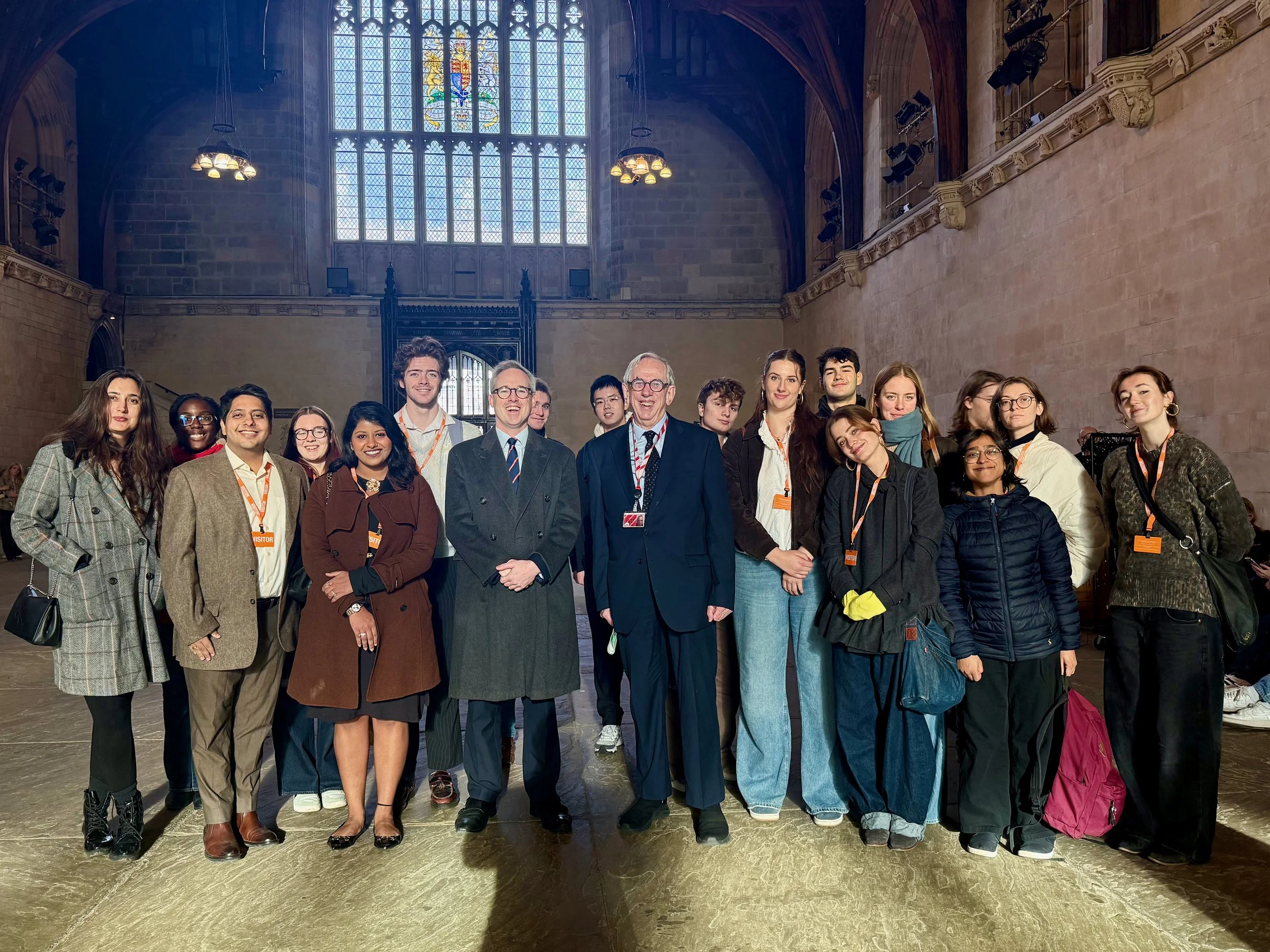
Westminster Hall
As part of the Emma Experience programme, a lively group of undergraduate and postgraduate students travelled from Emmanuel College to the Palace of Westminster for a tour kindly arranged through local MP Daniel Zeichner. For most, it was their first encounter with the heart of parliamentary democracy.
Students from a wide range of subjects took part, including law, politics, English, maths, history, architecture and public policy. A history student 2nd had recently been studying the evolving relationship between Crown and Parliament under the Tudors and Stuarts, was delighted to stand in St Stephen’s Hall, where many of those events unfolded. An Architecture student joined the visit for the chance to see one of the earliest major government buildings created in the Gothic Revival style, reflecting his interest in the politics of architectural design. For a first year law student, their interest had been piqued by study this year of constitutional law.
During the tour, the group witnessed the Speaker’s ceremonial procession into the House of Commons and visited the House of Lords — resisting, with some effort, the temptation to test the famous red benches.
Back in Westminster Hall, students were surprised to be welcomed by Lord Wilson (2002), former Master of the College, and The Rt Hon. The Lord Parkinson (2001). Both generously gave their time to talk about their work across Westminster and offered an insider’s perspective on how the UK’s political and policy systems operate. Lord Parkinson sported his tie with the familiar blue and pink stripes.
Many of the group stayed on afterwards to sit in the public gallery, where they were able to see Parliament in action as the Prime Minister delivered statements on the G20 and the war in Ukraine, followed by questions from Members of Parliament.
The visit offered students a vivid window into the workings of national governance and the living history of the Palace of Westminster. Reflecting on the trip, Emma Experience Director Dr Daniel McKay emphasised that the Community branch of the College’s co-curricular programme is shaped around giving students ways to give context to their academic work.
“Students study or research in a vast range of disciplines, but each of those viewpoints has something to offer our different communities,” he said. “Experiences like this help them recognise how their studies intersect with the questions and pressures shaping society, and how their own expertise and perspectives might make valuable contributions to finding solutions.”
